The Clinical & Economic Teardown of At-Home Salon Hygiene
Executive Summary: The Invisible Parlor Vector
For decades, consumer perception equated brick-and-mortar salon architecture—mirrored walls, hydraulic chairs, and retail display racks—with hygiene and clinical authority. However, recent epidemiological audits in urban centers across India reveal that high physical footfall, compressed technician turnover times, and bulk packaging economics frequently undermine sterilization protocols.
This investigation synthesizes three distinct investigative lenses:
- The Clinical Microbiologist & Dermatological Perspective: Evaluating bacterial colonization kinetics in heated wax reservoirs and non-autoclaved metallic tools.
- The Cosmetic Formulation Chemist Perspective: Contrasting multi-dip bulk jars against nitrogen-sealed, single-use mono-dose packaging.
- The Urban Consumer Economics Perspective: Calculating the true cost of parlor downtime, vehicular transit in Delhi NCR/Lucknow, and the risk premium of cross-infection.
1. The Microbiology of Shared Parlor Equipment
1.1 The Wax Pot Double-Dipping Dilemma
In high-volume commercial salons, wax heaters remain elevated at operational temperatures (typically between 45°C and 55°C) for 10 to 14 consecutive hours. A persistent clinical misconception among parlor staff is that operational wax temperatures act as a self-sterilizing medium.
According to microbiological guidelines established by the American Academy of Dermatology (AAD) and the Bureau of Indian Standards (BIS) for cosmetic safety, temperatures below 60°C do not achieve thermal bactericidal death for common cutaneous pathogens. On the contrary, wax maintained at body-adjacent heat provides a hospitable reservoir for:
- Staphylococcus aureus and MRSA: Frequently transferred via micro-follicular bleeding during rapid wax removal.
- Pseudomonas aeruginosa: Highly persistent in warm, viscous, moisture-trapping environments.
- Human Papillomavirus (HPV) & Molluscum Contagiosum: Viral particles that can survive on non-porous wooden spatulas dipped multiple times into the central container.
When an esthetician "double-dips" a wooden spatula into a 500g or 1kg communal wax pot after applying it to an open hair follicle, bacterial colonies are inoculated into the master pot. The next client—often treated minutes later—receives an active inoculum into freshly denuded skin pores, dramatically elevating the incidence of pseudofolliculitis, bacterial cellulitis, and hyperpigmentation flare-ups.
1.2 Metallic Tool Sterilization: Chemical Wipes vs. Medical Autoclaves
Cuticle nippers, blackhead extractors, and micro-needling accessories come into direct contact with bloodborne elements and lymph fluids.
| Sterilization Modality | Temperature / Chemistry | Pathogen Elimination Efficacy | Common Parlor Adoption Rate | DoorStep Diva Protocol |
|---|---|---|---|---|
| Alcohol Dip / Surface Wipe | 70% Isopropyl Alcohol (< 30s) | Incomplete; fails on spores & non-enveloped viruses | ~68% in local salons | Never used as primary |
| UV Light Cabinet | 254nm Ultraviolet Radiation | Surface-only; blocked by microscopic shadows/debris | ~22% in commercial parlors | Secondary storage only |
| Class-B Medical Autoclave | 134°C pressurized saturated steam (30 psi, 15m) | 100% complete spore & viral destruction | < 4% in non-medical salons | Standard for all metallic tool sets |
| Single-Use Sealed Disposables | Gamma-irradiated single packaging | Zero risk of prior human contamination | Rare in neighborhood parlors | 100% standard for sheets, gowns, spatulas |
2. Cosmetic Chemistry: Multi-Use Jars vs. Mono-Dose Ampoules
2.1 Atmospheric Oxidation and Active Degradation
High-performance cosmetic formulations—specifically L-Ascorbic Acid (Vitamin C), Retinol, Peptides, and Hyaluronic Acid—are thermodynamically unstable. Each time an esthetician unscrews a 500ml salon facial jar, two destructive processes occur:
- Photo-Oxidation & Free Radical Generation: Contact with ambient oxygen causes ascorbic acid to oxidize into dehydroascorbic acid (DHAA), rendering the facial chemically inert or pro-inflammatory.
- Microbial Seeding via Atmospheric Dust & Fingers: In busy commercial salons, ambient airborne particulate matter (PM2.5 / PM10 in Delhi NCR) enters the unsealed formulation, introducing fungal spores (Aspergillus, Malassezia).
2.2 The Mono-Dose Solution
At DoorStep Diva, skin care treatments rely strictly on hermetically sealed, nitrogen-blanketed mono-dose sachets and ampoules. Each tube or sachet contains the exact volume calibrated for a single facial protocol. It is cut open directly in front of the client's eyes, ensuring zero prior oxidation, maximum active molecular potency, and zero preservative overload.
3. Climate-Specific Esthetics: Delhi NCR vs. Lucknow Environmental Factors
Urban skin health is inextricably linked to localized ambient environmental stressors. A standardized parlor treatment failing to adjust for geographic air-quality indexes (AQI) often results in post-treatment barrier breakdown.
3.1 Delhi NCR: Particulate Barrier Repair Protocol
- Environmental Hazard: Severe winter AQI spikes (PM2.5 often exceeding 350 µg/m³), alkaline municipal hard water (TDS > 600 ppm), and high vehicular carbon deposition.
- Clinical Implication: Cutaneous lipid matrix breakdown, premature collagen degradation, and impaired stratum corneum permeability.
- DoorStep Diva Adaptation: In Delhi NCR, our doorstep artists bring customized barrier-repairing lipid treatments (ceramide NP, phytosterols, and pH 5.5 filtered distilled water rinses) to avoid subjecting newly exfoliated skin to municipal hard water.
3.2 Lucknow & Central UP: Alluvial Humidity & Sebaceous Congestion
- Environmental Hazard: Subtropical post-monsoon relative humidity (often exceeding 78% RH) coupled with airborne alluvial dust.
- Clinical Implication: Hyper-seborrhea, closed comedones, and superficial fungal overgrowth (Pityrosporum folliculitis).
- DoorStep Diva Adaptation: Salicylic acid deep-clearing rinses, non-comedogenic gel emulsions, and localized high-frequency antiseptic ionization to prevent post-waxing breakout episodes.
4. The Economic Unit Matrix: At-Home vs. Traditional Salon
A rational consumer analysis must account for transaction costs beyond the receipt invoice:
Total Cost = Direct Service Price + Transportation Cost + Opportunity Cost of Time + Health Risk Margin
- Transit & Congestion Friction: In Delhi NCR (South Delhi to Gurgaon or Noida corridors), round-trip salon travel averages 75–95 minutes. In Lucknow (Hazratganj to Gomti Nagar during evening rush hour), transit consumes 40–55 minutes.
- Waiting Room Idleness: Parlor scheduling systems frequently overbook by 20–30% to hedge against no-shows, resulting in an average 25-minute salon waiting room dwell time.
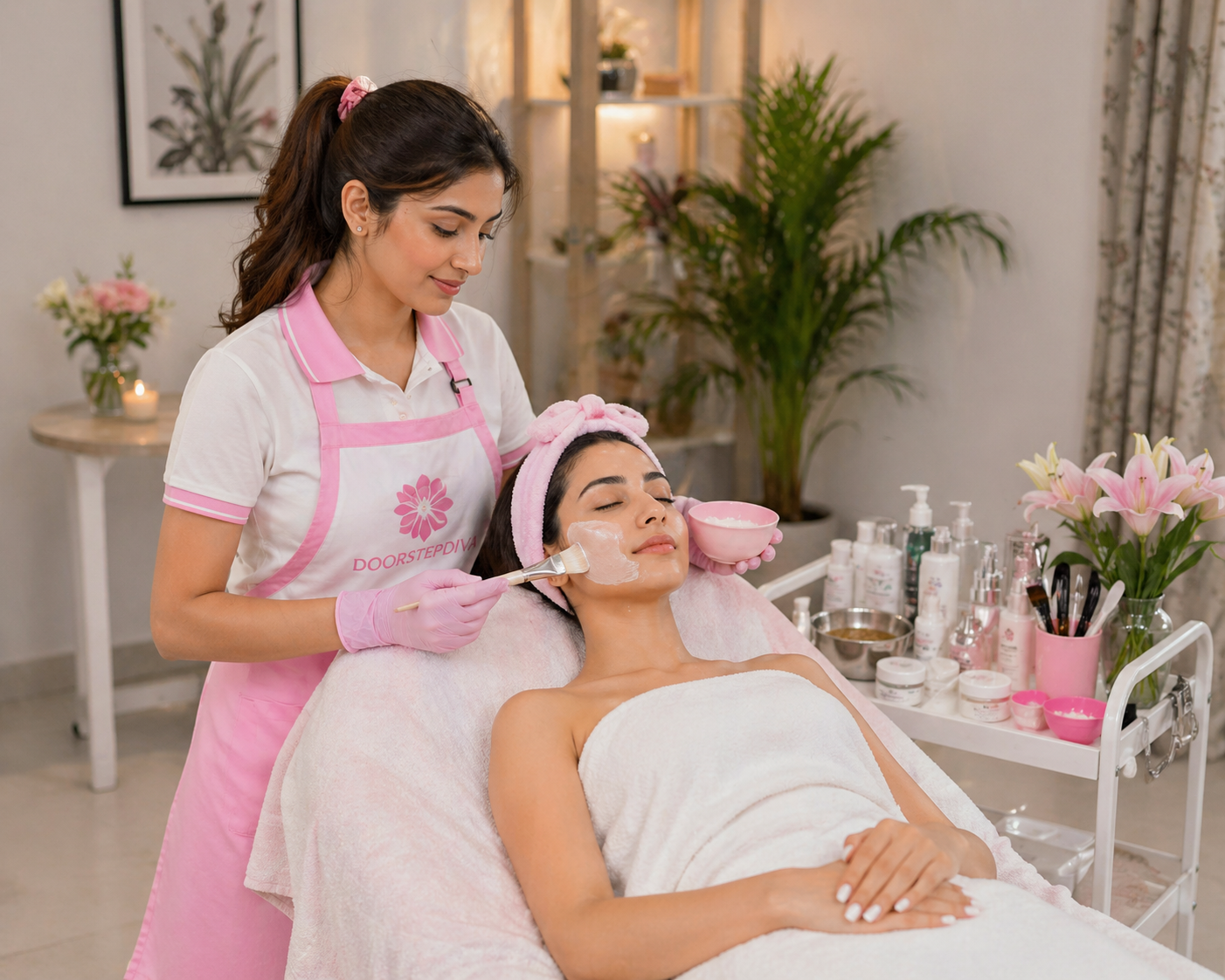
- The At-Home Efficiency Advantage: By transforming the client's sanitized bedroom or living room into a private treatment sanctuary, transit time is eliminated to exactly zero minutes.
5. The DoorStep Diva Five-Tier Safety Architecture
To formalize transparency, DoorStep Diva operates under a non-negotiable five-tier clinical protocol:
[1. Unsealed In Front of You]
   └── 100% disposable sheets, towels, spatulas, and headbands opened from sterile plastic seals.

[2. Pre-Packaged Mono-Dose Cosmetics]
   └── Single-client sealed skincare packs. Zero multi-use bulk tubs.

[3. Autoclaved Instruments]
   └── Metallic cuticles, tweezers, and extractors stored in indicator-strip surgical pouches.

[4. Background-Verified Certified Artists]
   └── Police-verified, credentialed female cosmetologists with mandatory continuous hygiene auditing.

[5. Zero Advance Risk]
   └── Post-service inspection payment via UPI or cash. No locked-in upfront subscriptions.
Conclusion & Next Steps
True luxury in beauty is not marble salon floors—it is uncompromising microbiological safety, clinical efficacy, and the convenience of personalized care in your own home.
To book your sanitized at-home session in Delhi NCR, Lucknow, or Ayodhya with certified female artists, visit DoorStep Diva Online Booking or consult our beauty coordinator directly on WhatsApp at +91 9129577514.